
Psychology that is thoughtful, relational & rooted in context.
Dharini is a counselling psychologist working across individual therapy, relationships, family systems, child and adolescent mental health, and school wellbeing. Her work begins with a simple idea: people make more sense when their story, relationships and environment are understood together.

A space that starts with understanding.
Dharini works with children, adolescents, adults, couples and families. Rather than fitting people into one method, she pays attention to the emotional world around the concern — lived experiences, relationships, beliefs, developmental stage and the pace at which change feels possible.
Her style is collaborative and reflective. Therapy can involve making sense of patterns, building language for difficult experiences, strengthening emotional awareness and finding more workable ways of relating to yourself and the people around you.
Care that stays human.
The work is professional and evidence-informed, but never mechanical. These principles guide how Dharini approaches counselling across ages and concerns.
Curiosity before conclusions.
Symptoms and behaviour are explored with curiosity, rather than becoming the whole definition of a person.
Context matters.
Family, relationships, school, identity, culture and life experiences can all shape what someone is carrying.
Change is collaborative.
Therapy is not something done to a client. Meaningful work develops through conversation, reflection and a pace that feels workable.
Student wellbeing as a shared system of care.
Dharini’s work also extends into school mental health. Alongside individual counselling, her school-based practice has involved one-to-one support, workshops, reflective conversations and wellbeing initiatives that help students, teachers and families build a stronger shared language around mental health. At Gems Genesis International School, the counselling team has also supported the school’s participation in the pan-India SIMHA–TISS School Mental Health Review Tool pilot.
This systems perspective matters because a child’s wellbeing is rarely held by one person alone. Teachers, counsellors, parents, peers and school culture all become part of the support around a young person.
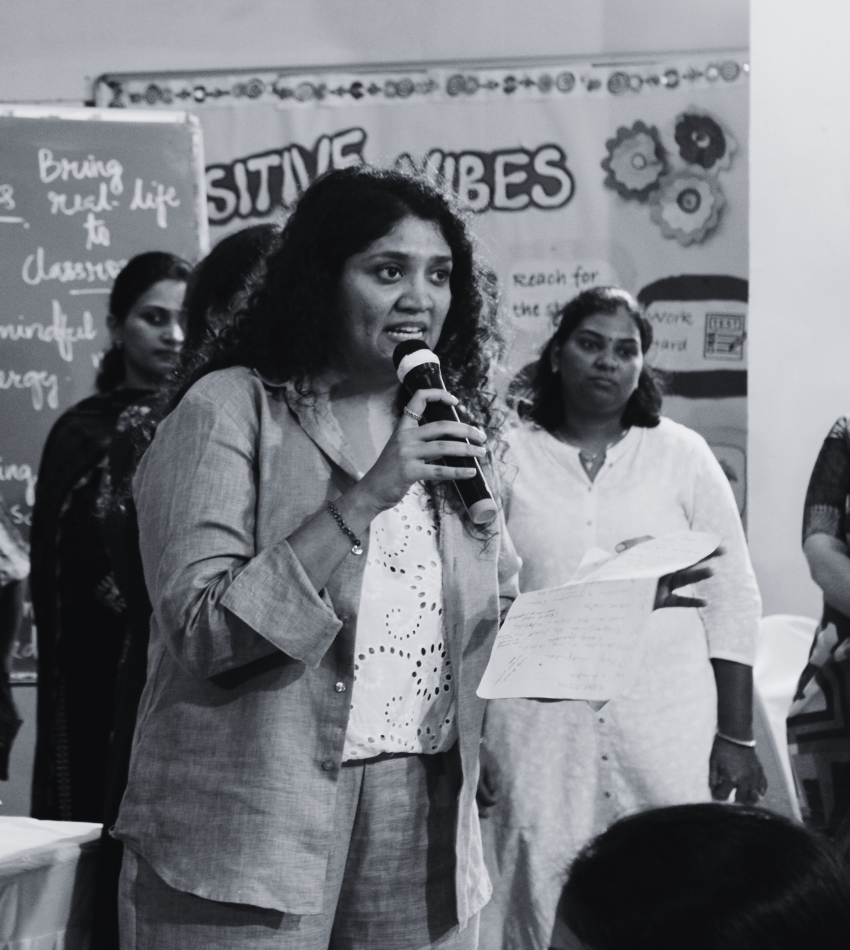
The hidden threads of student mental health.
Dharini has been part of the counselling team behind Interwoven: The Hidden Threads of Student Mental Health — a space designed to bring school counsellors, educators and mental health professionals together around the often-unseen systems that support student wellbeing. The first conference brought together more than 70 educators and counsellors from across Gujarat for shared learning and reflection.
The conversations reflect an idea central to her work: sustainable mental health support grows when the adults and systems around a child learn, reflect and respond together. The initiative has explored themes including student wellbeing, school mental health, neurodevelopment, digital living and the role of educators, counsellors, families and peers.
